A Shift Alarm Is Not a Safety Certificate: Recall Certification for Cross-Testbed Intrusion Detectors
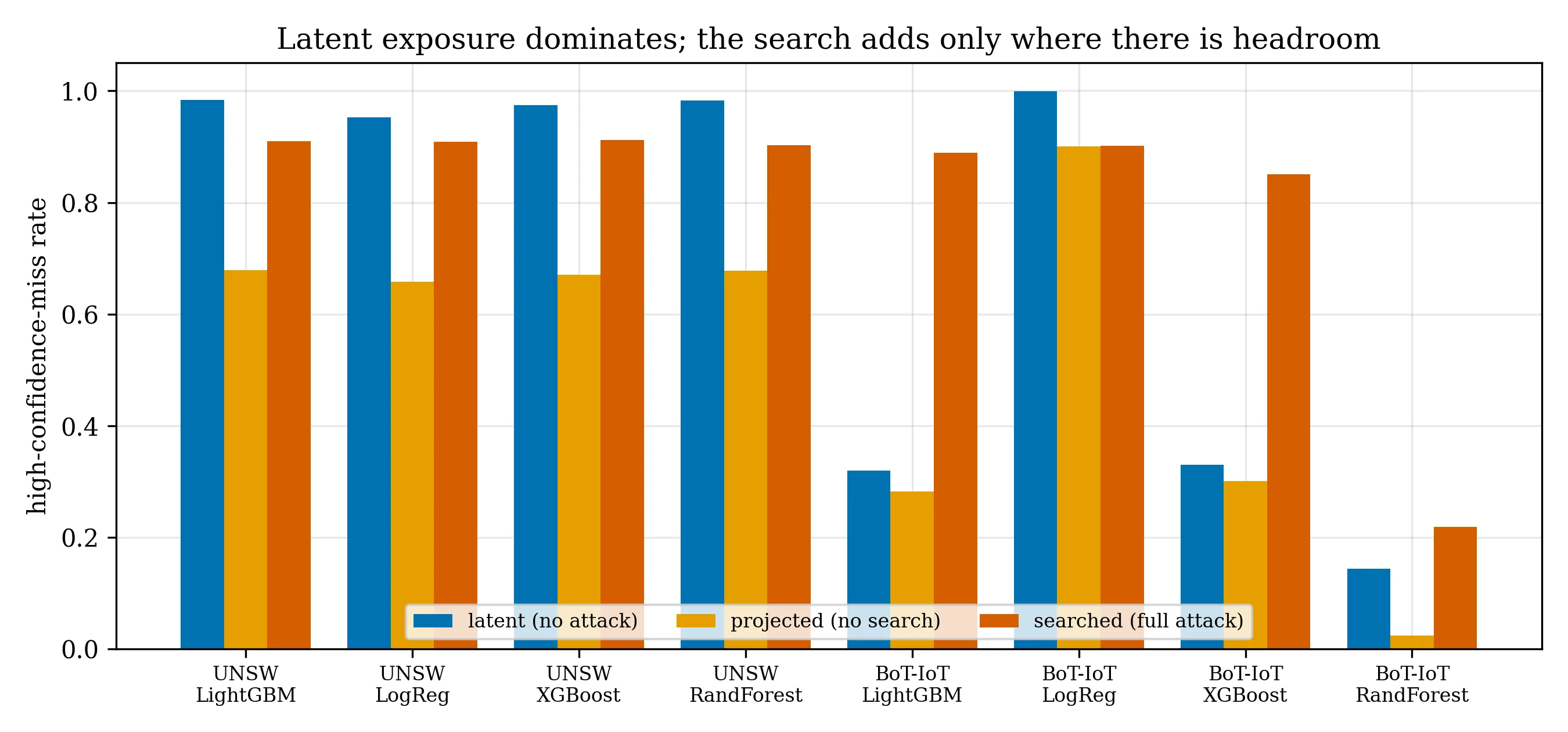
Moved to a new network, detectors call 68% of real attack flows benign with high confidence, and label-free monitors can stay silent.
The discovery in one figure
Swipe to see the whole figure
The paper in five minutes
An intrusion detector moved to a different network has no attack labels there, so operators watch it with label-free monitors. This paper asks whether those monitors can vouch for it. Most of the damage is done before any attacker arrives, a constrained attacker widens the gap only where the detector still has room to fail, and the one check that reliably told the dangerous cases apart was a small labelled audit.
The research question
When a detector moves to a network with no attack labels, can label-free monitors tell whether it still catches attacks, and can a constrained attacker exploit what they miss?
How it works
Four NetFlow v2 datasets give twelve ordered transfers; four model families over five seeds give 240 configurations, which the paper reads as correlated rather than independent. The latent miss rate is measured on real flows. A query-only attacker limited to traffic-plausible feature changes then searches for high-confidence misses, and its effect is measured against the projected real flow rather than a filtered baseline.
- 01Transfer the detectorstwelve ordered pairs, four models, five seeds, 240 configurations
- 02Measure the latent miss ratereal attack flows called benign at high confidence, no attacker
- 03Attack within constraintsquery-only, up to 200 queries per flow, traffic-plausible changes
- 04Test monitors and a defenceATC, confidence drift, conformal abstention, responder-side features
- 05Price a labelled auditone-sided Clopper-Pearson bound on recall
Experimental results
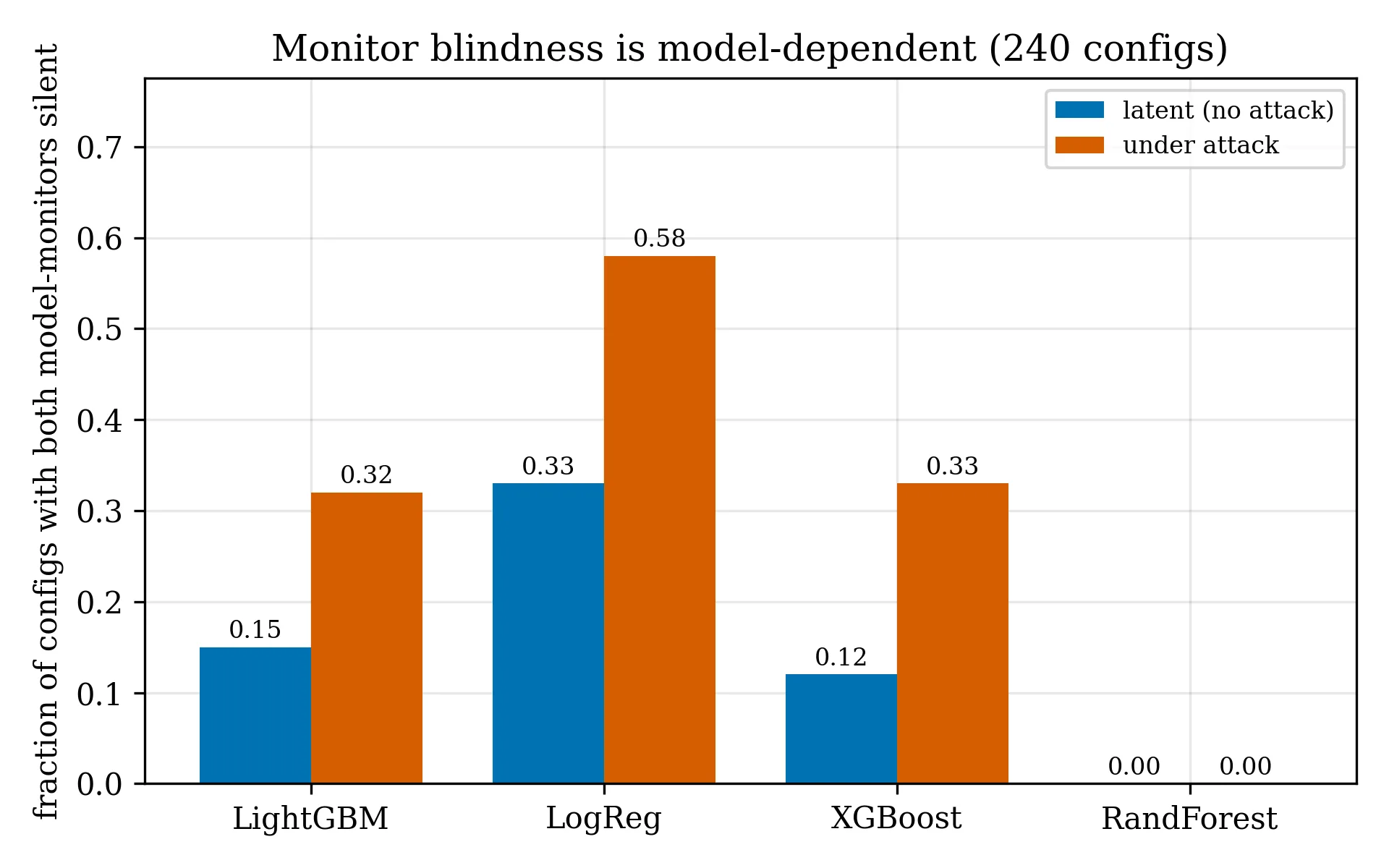
With no attacker, the transferred detector labels a mean 68% of real attack flows benign at high confidence. The attacker pushes that rate above one half in 145 configurations, and in 74 of them both confidence monitors stay silent. It adds nothing where the detector is already saturated, and a random forest largely resists it. Watching responder-side features fails its pre-registered bar, and an approximate conformal drift alarm did not separate the cases, alarming on 0.92 of safe and 0.84 of unsafe configurations. A gate that trusts the monitors accepts an unsafe detector in 15.0% of configurations; a 10-flow attack-reference recall audit does so in 0.03% of simulated audits.
0.8000.7070.6850.524Mean over the whole matrix: 0.679.
15.0%0.03%Unsafe means true recall below 0.5. The monitor gate is counted over configurations and the audit over simulated audits. 0.03% is an empirical frequency on this benchmark, not a guarantee.
- 68%of real attack flows called benign at high confidence, no attacker
- 74 / 145configurations past a 50% miss rate with both monitors silent
- 0.03%of simulated 10-flow audits accept an unsafe detector, against 15.0% of configurations for the monitor gate
Stated honestlyThe paper claims no new theorem and no new monitor: the monitoring blindness and its formal statement are from Ahmed et al. (2026), and the audit is standard finite-sample statistics. Attacks are in feature space only, with no wire-level claim. The audit assumes known attacks can be replayed and certifies recall against that reference set only.
Figures from the paper
Figures as generated by the paper’s own analysis pipeline.
What this changes
A shift alarm and a safety certificate are different things. Evidence that a transferred detector still works has to include labelled attacks, and the paper measures what that costs: cheap to flag a broken detector, expensive to clear a working one.
Citation
Manuscript in preparation. Reach me at rajveerpall04@gmail.com.