Confidently Wrong: Ranking Inversion in Cross-Network Denial-of-Service Detection
On a new network, DoS detectors do not decay toward chance: many pass through it and score attacks below benign traffic.
The discovery in one figure
Swipe to see the whole figure
The paper in five minutes
Flow-based denial-of-service detectors report accuracy above 99%, then lose most of that skill on a different network. This paper looks at the character of that loss. Where the ordering of scores survives the move, choosing a new threshold repairs it. Where the ordering has inverted, no threshold can, and the scoring function itself has to change.
The research question
When a DoS detector moves to a new network, does it fail at the threshold or at the ranking, and which remedies can work?
How it works
Four model families are trained on four independently captured testbeds under a published common feature set, and every ordered pair of testbeds is evaluated over five seeds.
- 01Four testbedsindependently captured, one published common feature set
- 02Four model familiestrained on each testbed
- 03Every ordered pair12 cross-network transfers, five seeds, 240 evaluations
- 04Diagnose the failureranking loss versus threshold loss, then test remedies
Experimental results
Transfer does not decay toward chance; it passes through chance. 108 of 240 run-level evaluations score below ROC-AUC 0.5, and the worst reaches 0.0697, where negating the score would give 0.9303. Eleven of twelve testbed pairs fail at the ranking rather than the threshold. Retraining on ten balanced labelled target flows reaches median macro-F1 0.7253, against 0.3919 without adaptation.
- 108 / 240evaluations below ROC-AUC 0.5
- 0.0697worst ROC-AUC (0.9303 if negated)
- 11 / 12testbed pairs fail at the ranking
Figures from the paper
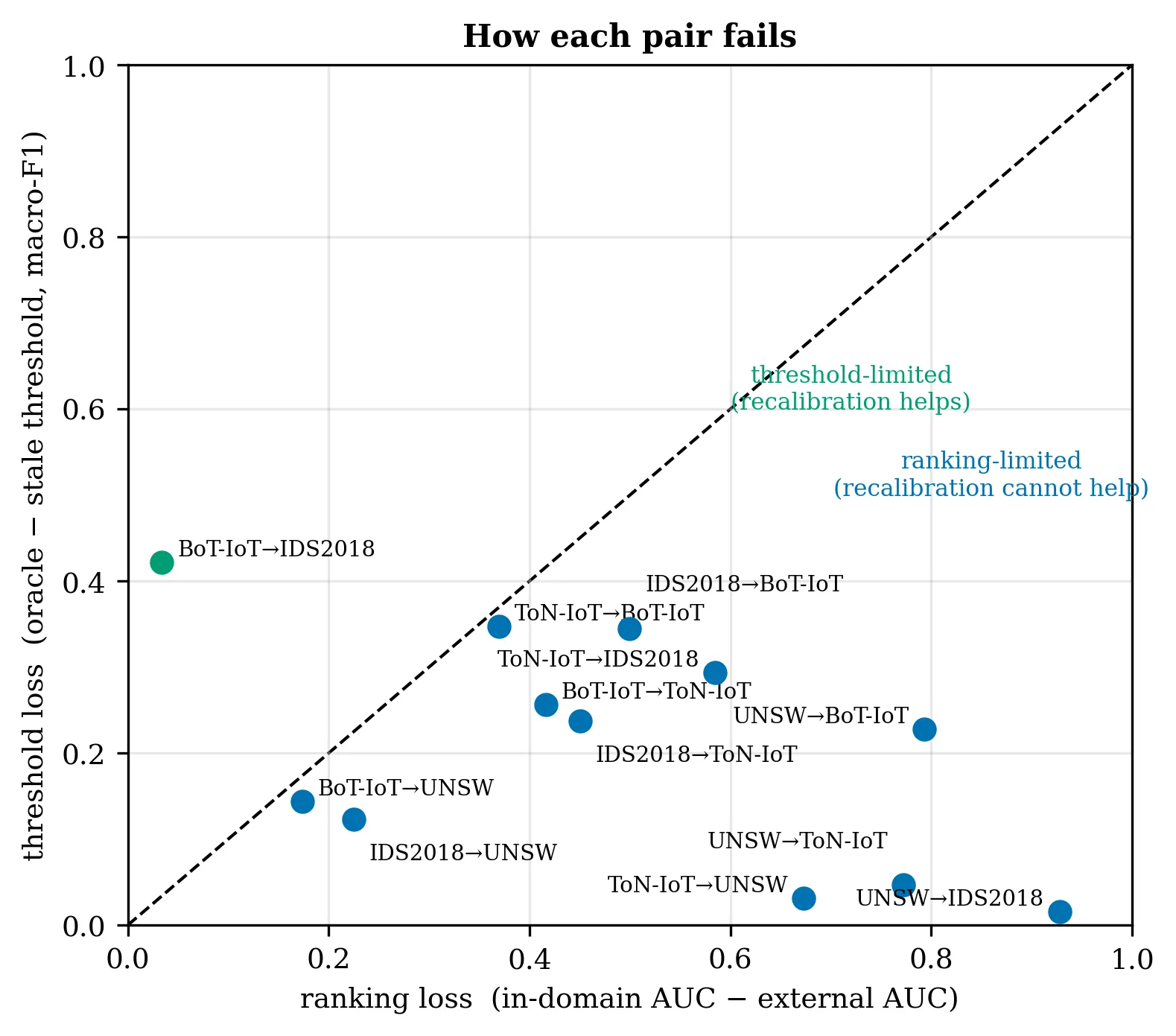
Figures as generated by the paper’s own analysis pipeline.
What this changes
Cross-network evaluation has to separate ranking failure from threshold failure, because the two admit different fixes.
Resources
Not public yetCode is not public yet.
- Network Security
- Deployment Shift
Citation
Manuscript. A draft is available on request. Reach me at rajveerpall04@gmail.com.