When the Gate Stays Closed: Empirical Evidence of Near-Zero Cross-Sectional Predictability in Large-Cap NASDAQ Equities Using an IC-Gated Machine Learning Framework
A deployment gate for financial ML — and the discipline to report that it stayed closed.
The discovery in one figure
The paper in five minutes
Most trading-model papers report wins. This one builds the exam a model must pass before it is allowed to trade real money — and then reports that its own model failed that exam twelve times out of twelve. That is the contribution: a statistical gate that separates 'looks profitable in a backtest' from 'provable skill'. A naive statistical test would have green-lit a skill-less model 11.8% of the time; the full gate never did. One more twist: the model's probability estimates were nearly perfect even though it had zero predictive skill — proof that a well-calibrated model is not the same as a deployable one.
The research question
Can a financial ML model prove cross-sectional predictive skill before deployment — and what should happen when it cannot?
How it works
IC-Gated Deployment Framework: a two-stage statistical gate (Newey–West HAC t-test on daily information coefficients plus permutation confirmation) over 12 expanding walk-forward folds, 1,512 out-of-sample days, with isotonic calibration and a momentum positive control.
- 01Build honestly49 strictly causal features, 30 NASDAQ stocks, no lookahead
- 02Walk forward12 expanding-window folds, 1,512 out-of-sample days, 2-day embargo
- 03Measure skilldaily information coefficient → Newey–West HAC t-test
- 04Confirm by permutationboth stages must pass — either fails, no deployment
- 05Report the nullgate closed 0/12; calibration excellent anyway (ECE < 0.025)
Experimental results
Mean IC −0.0005; the gate opens in 0 of 12 folds. Calibration stays excellent (ECE < 0.025) despite zero discrimination — calibration quality is not deployment readiness. The naive t-test alternative false-positives 11.8% of the time; the full gate, 0.0%.
11.8%0.0%Simulated null (no real signal): the naive test deploys anyway; the gate never does.
- 0 / 12folds passing the deployment gate
- < 0.025ECE while IC ≈ 0 — calibration ≠ readiness
- 11.8% → 0%false-positive rate, naive test → ICGDF
Figures from the paper
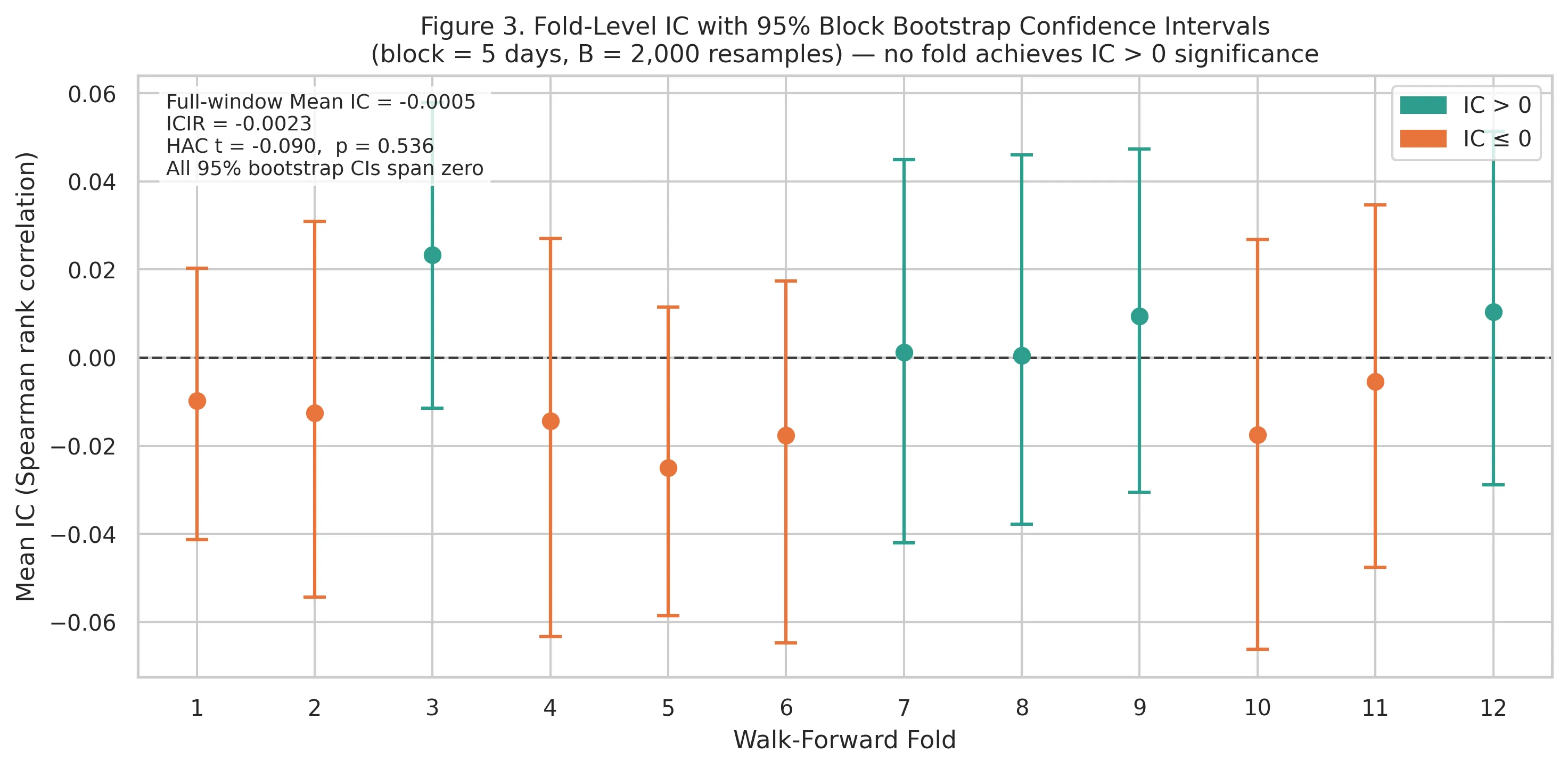
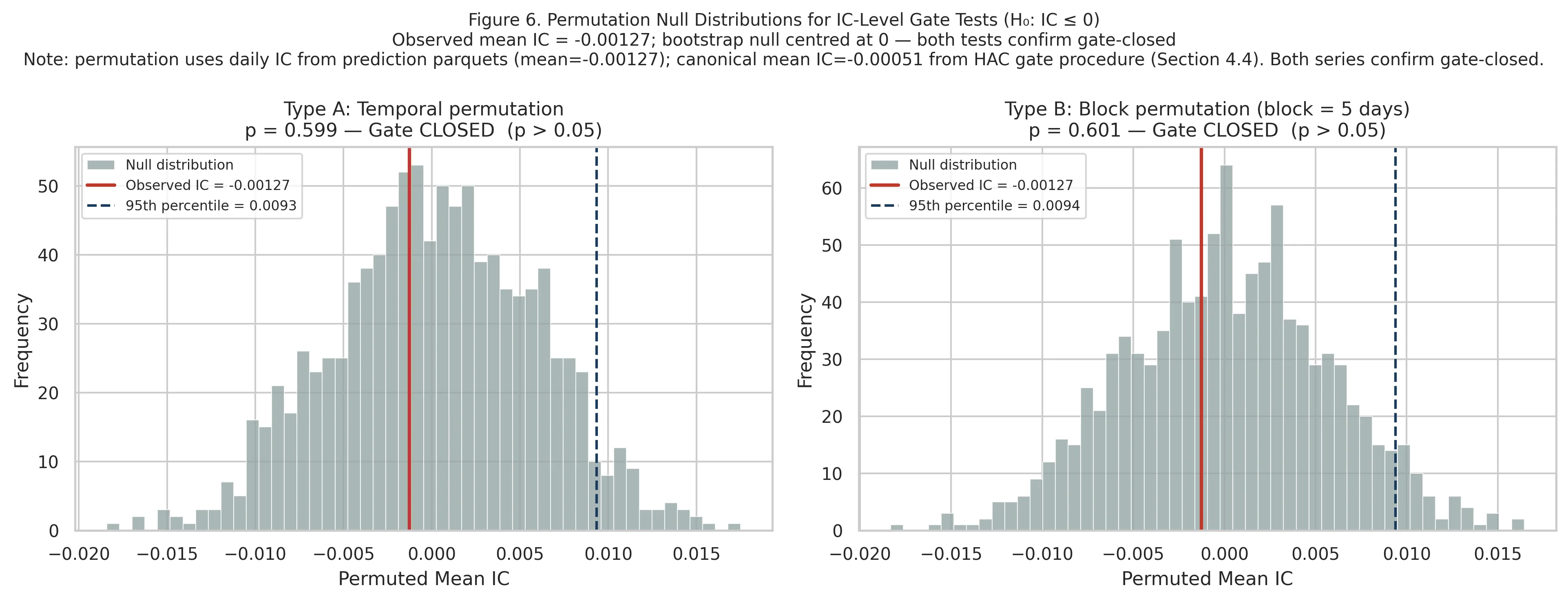
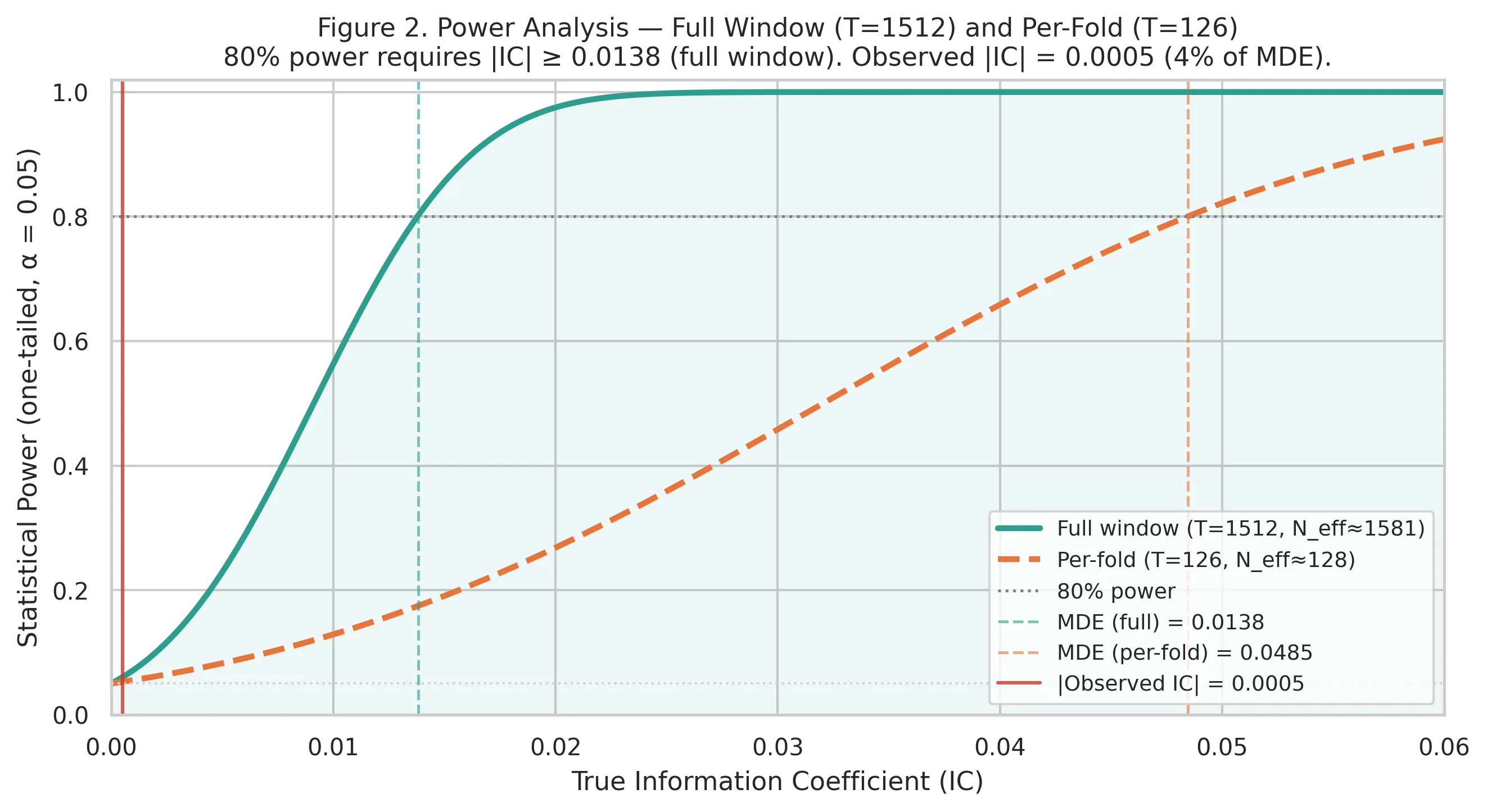
Figures generated by the paper's own pipeline — reproducible from the repository.
What this changes
An honest null result engineered as methodology: the same audit-first stance the program applies to healthcare and lending, applied to the temptation-rich domain of trading.
Citation
Manuscript under review — citation will be posted on acceptance. Reach me at rajveerpall04@gmail.com.