Who Bears the Burden? Heterogeneous Racial Approval Differentials in U.S. Mortgage Lending: Causal Forest DML on 42 Million HMDA Applications
Not whether an average penalty exists, but who bears it — and through which underwriting channel.
The discovery in one figure
The paper in five minutes
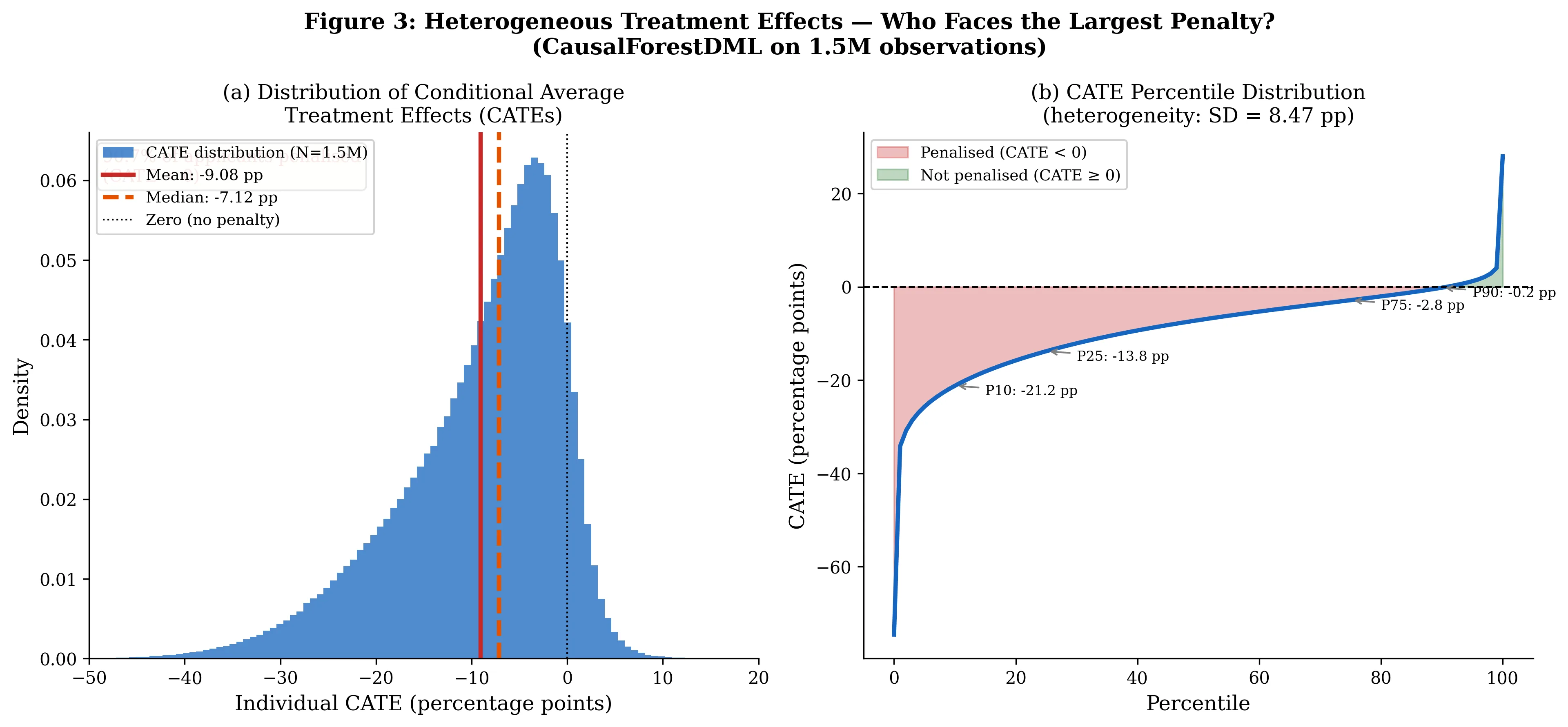
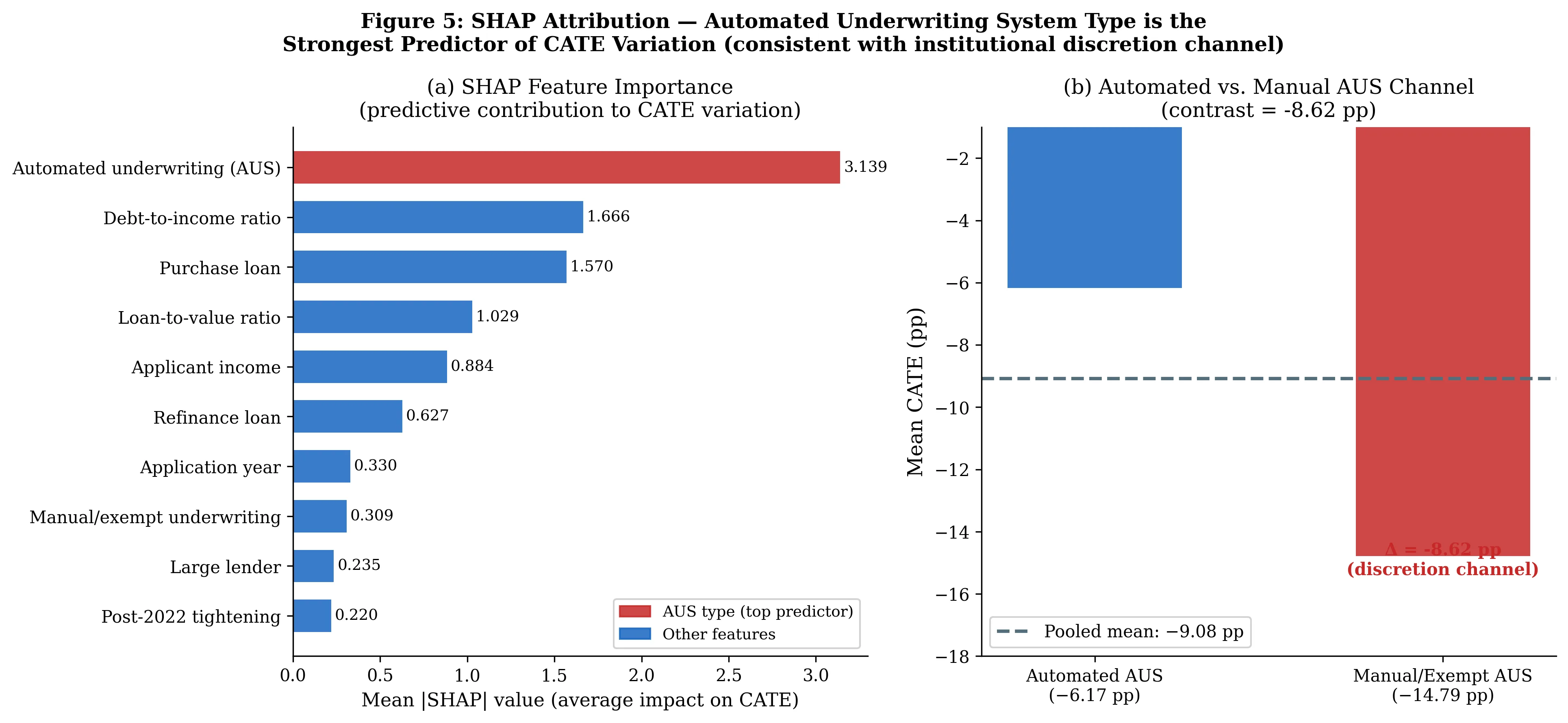
Knowing the average approval gap is not enough — averages hide who actually pays. Using methods from modern causal inference (the same family behind clinical-trial analysis), this paper estimates the approval penalty for each applicant profile across 42 million mortgage applications. The distribution is wide: nine in ten Black applicants face some estimated penalty, and the decisive factor is not the applicant but the process — applications handled by human underwriters carry more than double the penalty of those decided by automated systems. That points the fairness question at something a regulator can act on: how applications are routed.
The research question
Average disparity estimates hide distribution: which applicant profiles carry the largest conditional racial approval penalty, and is the mechanism applicant- or lender-controlled?
How it works
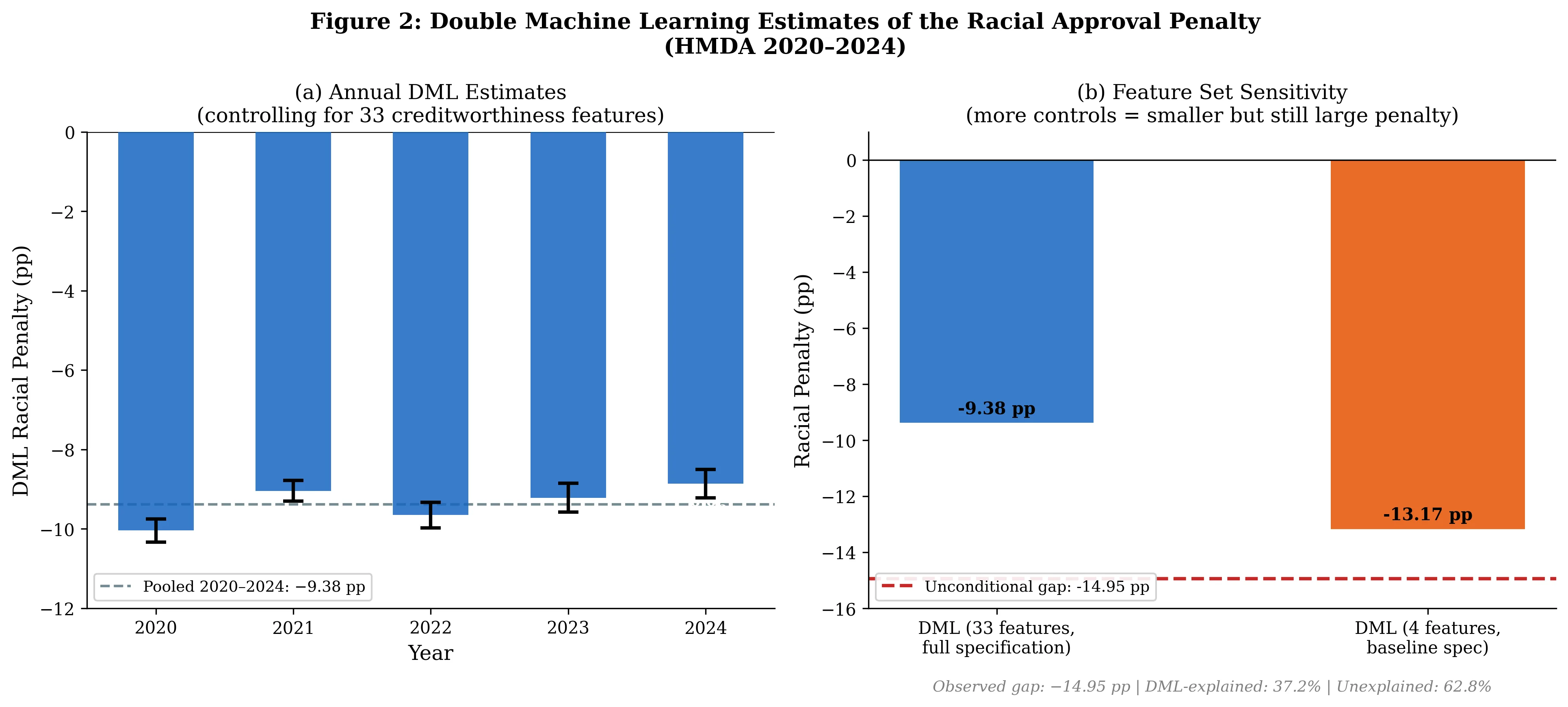
Partially linear Double Machine Learning with LightGBM nuisances and 5-fold cross-fitting; causal-forest CATE estimation with SHAP attribution; placebo, Oster, and Cinelli–Hazlett sensitivity analyses; within lender-year comparisons.
- 01Engineer at scale42M HMDA applications → 2M/1.5M estimation samples
- 02Isolate the differentialdouble machine learning, LightGBM nuisances, 5-fold cross-fitting
- 03Map who bears itcausal forest estimates the penalty per applicant profile
- 04Find the mechanismmanual vs automated underwriting · same lender, same year
- 05Attack the resultplacebo shuffles · Oster bounds · Cinelli–Hazlett sensitivity
Experimental results
Pooled conditional differential −9.39 pp with wide heterogeneity (CATE SD 8.47 pp); 90.7% of Black applicants face a negative estimated effect. The channel is decisive: manual underwriting −14.79 pp vs automated −6.17 pp; −7.13 pp persists within the same lender and year.
−14.79 pp−9.39 pp−7.13 pp−6.17 ppBar length = size of the estimated Black–White differential (all negative). The channel, not the applicant, is decisive.
- −9.39 ppconditional differential (pooled DML)
- −14.79 vs −6.17manual vs automated underwriting (pp)
- 90.7%of Black applicants with negative effect
Stated honestlyLevel treated as an upper bound (no credit scores in HMDA); the channel contrast is the robust object.
Figures from the paper
Figures generated by the paper's own pipeline — reproducible from the repository.
What this changes
Points the fairness question at an actionable mechanism — lender-controlled routing and handling — rather than at applicant characteristics.
Citation
Manuscript under review — citation will be posted on acceptance. Reach me at rajveerpall04@gmail.com.