Privacy-Preserving Federated Learning for Diabetes Risk Prediction Across Demographically Heterogeneous Hospital Nodes
Federated diabetes screening audited on four deployability axes at once — generalisation, fairness, calibration, and privacy — not just accuracy.
The discovery in one figure
The paper in five minutes
Hospitals cannot share patient records, so how do they train one model together? Federated learning sends the model to the data instead of the data to a server. This paper checks what federated papers usually don't: whether the jointly trained model still works on a different population of 1.28 million people, whether it treats the elderly fairly, whether its probabilities are honest, and whether formal privacy protection actually holds. Three of the four go surprisingly well — the federated model beats the centralized one externally. The fourth is an honest negative: differential privacy destroys the model at realistic settings, and the paper says so plainly.
The research question
Federated learning is sold on privacy. But does a federated clinical model also generalise externally, treat age groups fairly, and stay calibrated — simultaneously?
How it works
Three demographically heterogeneous simulated hospital nodes over NHANES; FedAvg / FedProx / FedNova / SCAFFOLD vs centralized controls; external validation on 1.28M BRFSS records; isotonic/Platt/temperature recalibration; DP-SGD ε-sweep with Opacus. A 4-page distillation is prepared for the ML4H 2026 Findings track.
- 01Split realisticallythree demographically unequal simulated hospital nodes
- 02Train federatedFedAvg · FedProx · FedNova · SCAFFOLD vs centralized controls
- 03Validate externally1.28M BRFSS records — a population no node ever saw
- 04Audit fairness + calibrationelderly–young gap · ECE with recalibration ladder
- 05Stress privacyDP-SGD ε-sweep — where utility survives, and where it collapses
Experimental results
FedAvg reaches external AUC 0.757 [0.756–0.758], beats centralized XGBoost (0.700), shows a 40% smaller internal–external gap than the matched centralized model (0.031 vs 0.052 — partly explained by data composition, stated openly), narrows the elderly–young fairness gap by 21.7%, and recalibrates from ECE 0.276 to 0.001. DP-SGD collapses utility at ε ≤ 5: current per-node sizes give no free privacy guarantee.
0.7570.7490.700The federated model generalises better than both centralized controls.
- 0.757FedAvg external AUC [0.756–0.758]
- −21.7%elderly–young fairness gap reduction
- 0.276 → 0.001ECE after isotonic recalibration
- ε ≤ 5DP-SGD utility collapse point
Figures from the paper
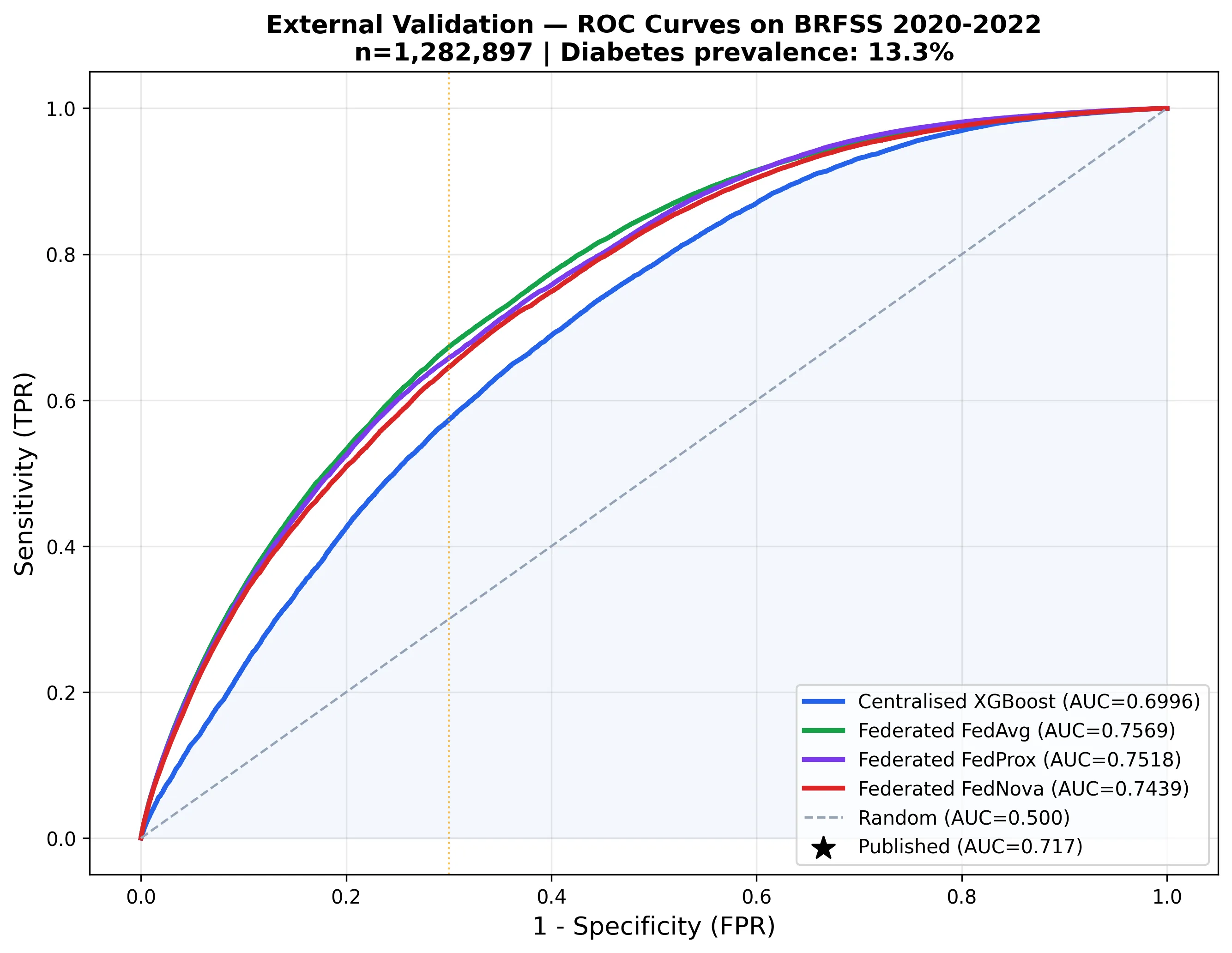
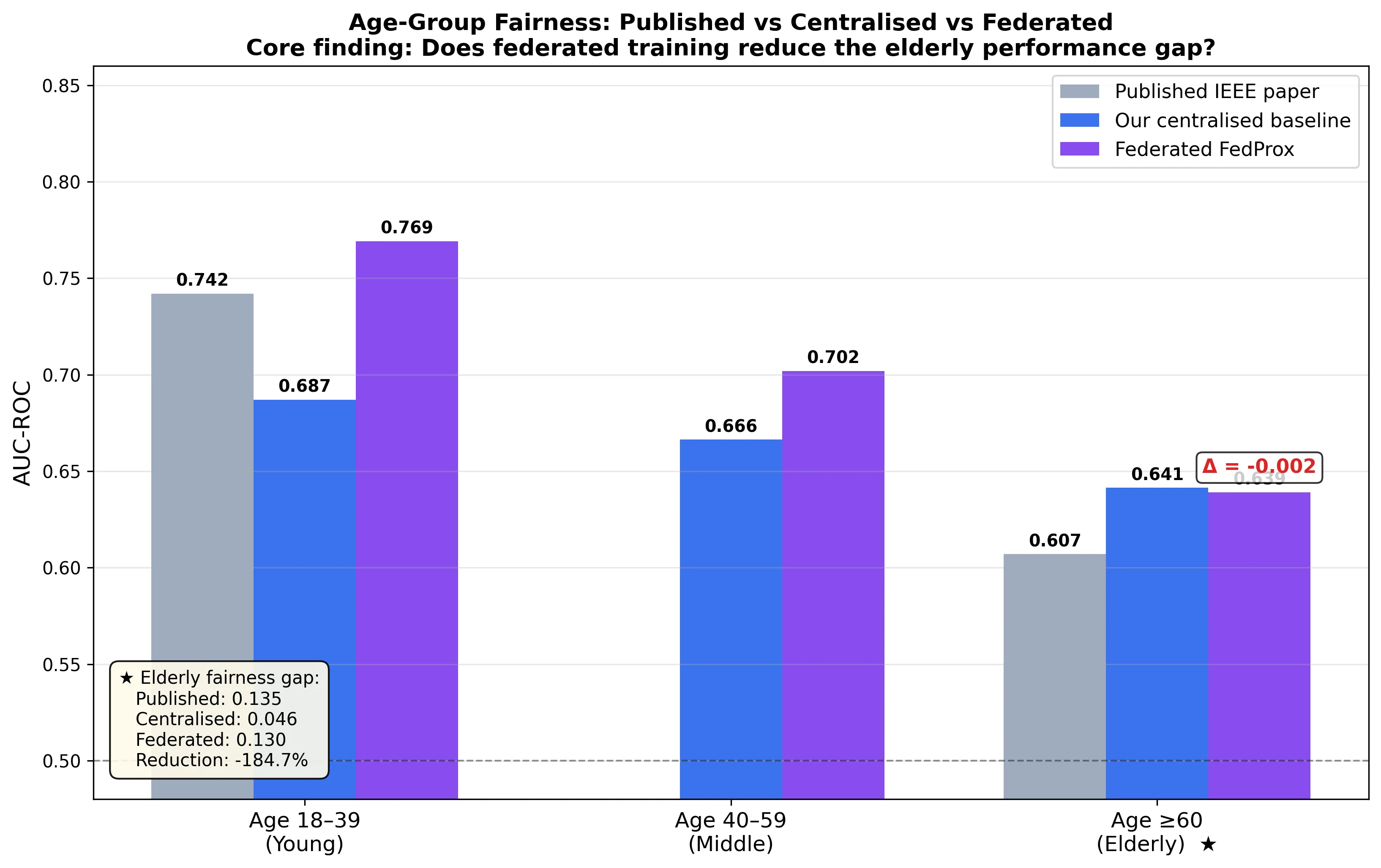
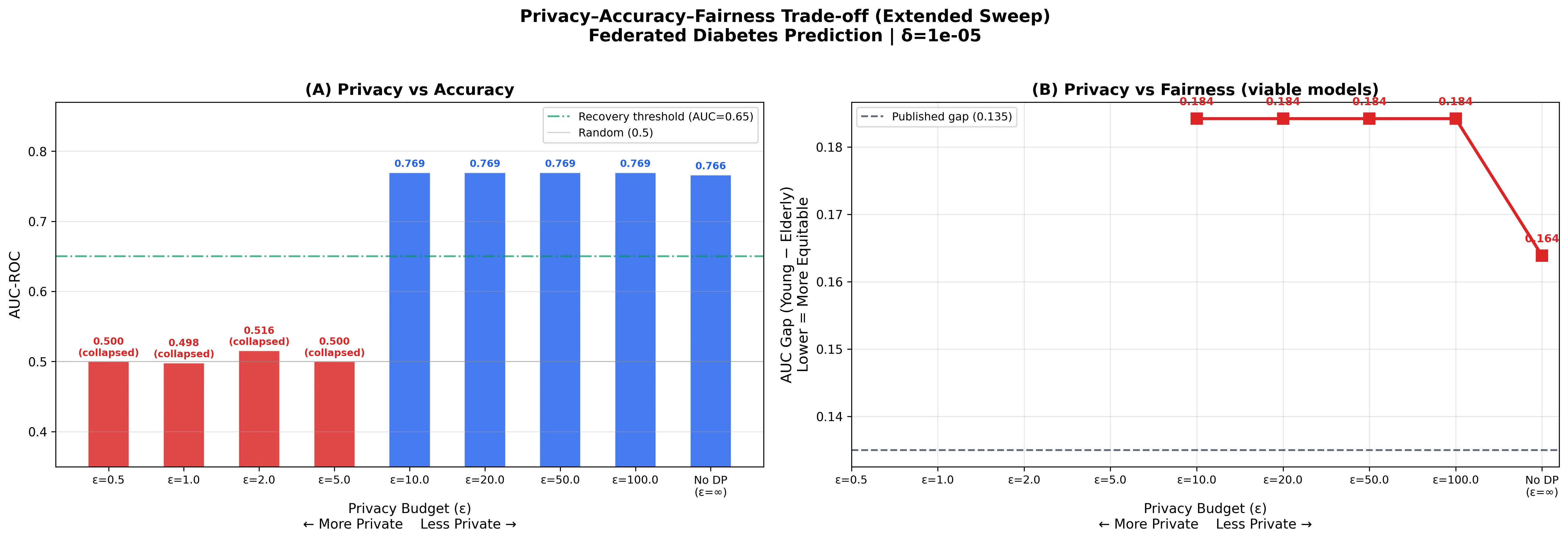
Figures generated by the paper's own pipeline — reproducible from the repository.
What this changes
Moves FL evaluation beyond 'privacy by architecture' toward audit-first deployment evidence — including the honest negative on differential privacy.
Citation
Manuscript under review — citation will be posted on acceptance. Reach me at rajveerpall04@gmail.com.