Cross-Platform Generalisation Failure in Mental Health NLP: A Five-Axis Fairness Audit of Transformer Models on Social Media
Mental-health classifiers that look near-perfect in-platform collapse across platforms — on discrimination, calibration, equity, and even their explanations.
The discovery in one figure
The paper in five minutes
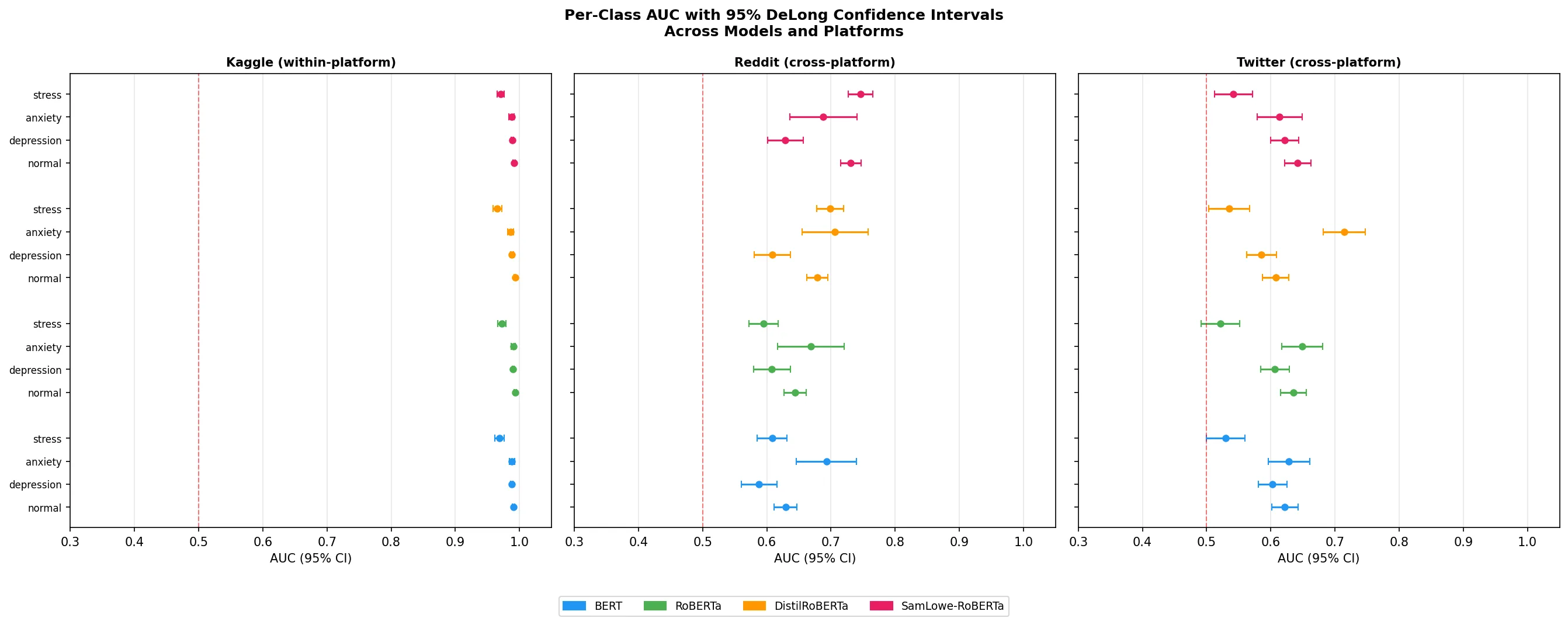
Software that scans social-media posts for signs of depression or anxiety is usually trained and tested on a single platform, where it looks near-perfect. We took such models — AUC above 0.98 — and simply moved them to Reddit and Twitter. Accuracy collapsed by a third. Their confidence scores became badly dishonest. Fairness metrics failed for exactly the classes that matter clinically. And the words the models relied on changed almost completely from platform to platform — the model was never reading what its developers thought it was reading.
The research question
Mental-health NLP models report AUCs near 0.99 on one platform. What survives when the same model meets Reddit or Twitter language?
How it works
CPFE: a five-axis cross-platform audit — discrimination, calibration, statistical significance, prediction equity, attribution stability — across BERT/RoBERTa variants, five seeds, with DeLong CIs, bootstrap ECE, Bonferroni-corrected tests, and gradient-saliency Jaccard analysis.
- 01Train in-platformtransformer classifiers, 35,556 posts, five seeds
- 02Audit on five axesdiscrimination · calibration · significance · equity · attribution
- 03Cross platformssame models, Reddit and Twitter language
- 04Attempt repairtemperature scaling fixes calibration only; fine-tuning recovers more
Experimental results
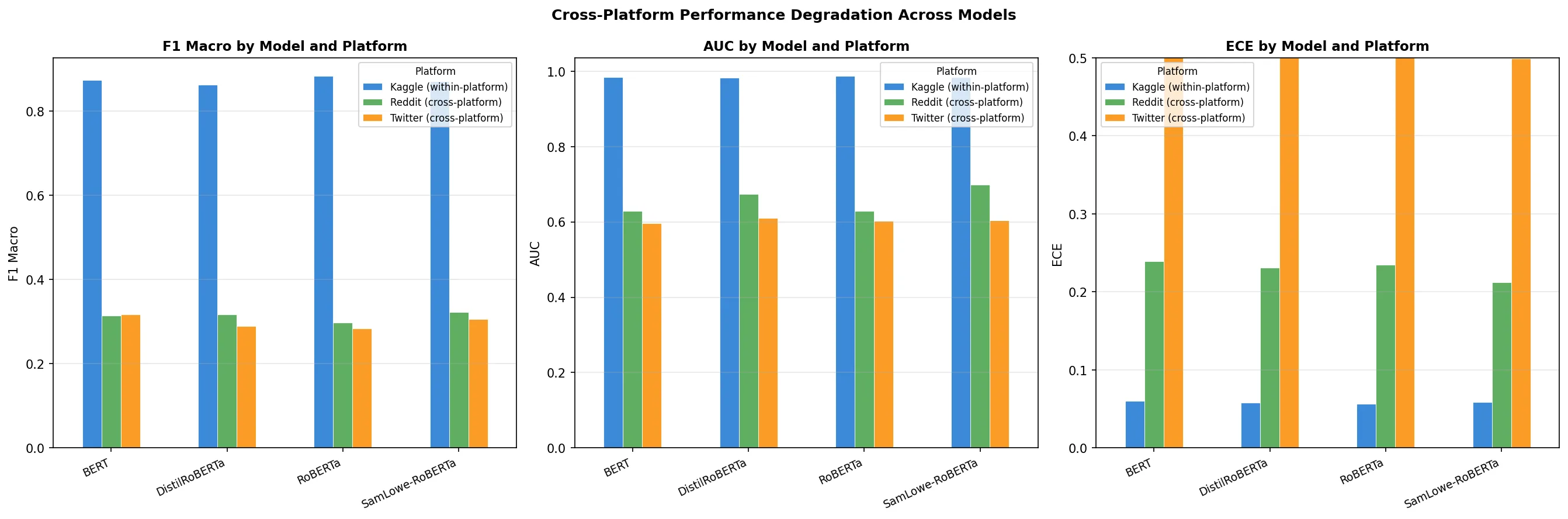
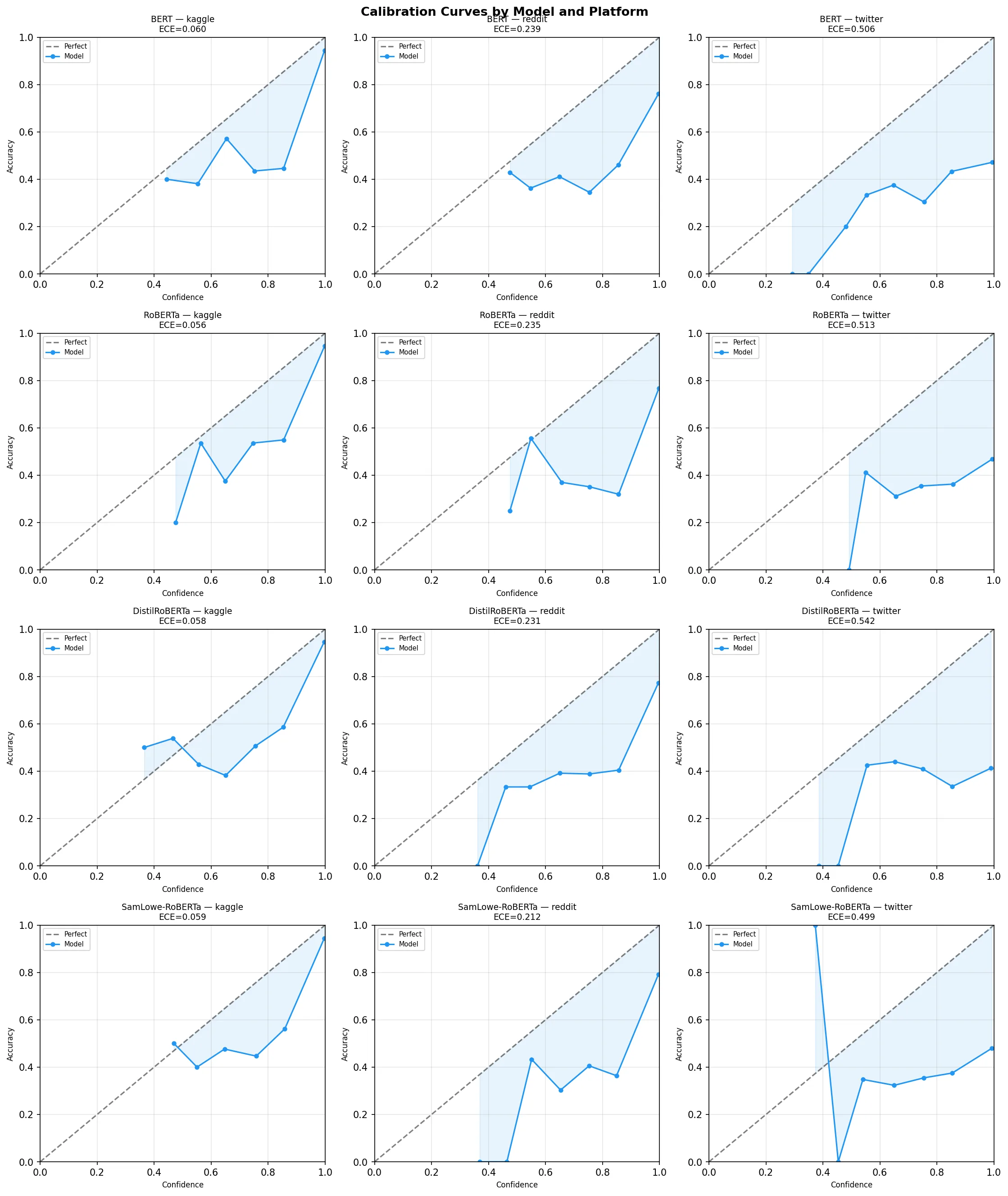
Within-platform AUC of 0.983–0.987 degrades 30–40% cross-platform; ECE inflates up to 0.54; equity metrics fail for clinical proxy classes; attribution overlap falls to Jaccard ≈ 0 in 13 of 16 model–class pairs. Temperature scaling repairs calibration (−88% ECE) but not discrimination; target-domain fine-tuning recovers far more.
0.056–0.0600.196–0.2290.499–0.542Bars drawn at the lower bound of each reported range — the conservative reading.
- 0.983 → ~0.65AUC under platform shift (−30–40%)
- ≈ 0attribution Jaccard in 13/16 pairs
- −88%ECE after temperature scaling
Stated honestlyLabels are clinical proxies from emotion mappings, not diagnoses.
Figures from the paper
Figures generated by the paper's own pipeline — reproducible from the repository.
What this changes
Fairness itself is shown to be a deployment-shift casualty: every trustworthiness axis can fail while the benchmark number stays excellent.
Citation
Manuscript under review — citation will be posted on acceptance. Reach me at rajveerpall04@gmail.com.